In reality, most SMEs are not struggling because they cannot create content. They are struggling because they lack direction, consistency, and a system that turns attention into enquiries. AI can speed up output, but it does not automatically give you a clear market position, a strong brand voice, or predictable growth.
This blog clarifies when AI is enough, when an agency is worth it, and what the agency role looks like now.
What AI Can Do Well for Marketing in 2026
1. Faster content drafting and variations
AI is excellent for speed. It can help you create first drafts of captions, blog outlines, ad copy variations, hooks, video scripts, and headline options. This reduces the time it takes to go from idea to something usable, especially when your team is small.
2. Quick research summaries and idea generation
AI can summarise competitor pages, pull out key themes, and generate topic ideas based on common customer questions. It’s also useful for brainstorming angles, frameworks, and ways to explain a concept simply.
3. Repurposing long-form content into multiple formats
If you already have a blog, podcast, webinar, or long video, AI helps you turn that into smaller assets quickly. It can extract key points, create social snippets, and generate multiple caption options based on the same core content.
4. Automating simple workflows (scheduling, reporting, templates)
AI can support operational tasks such as drafting reporting summaries, creating reusable templates, and even helping with scheduling workflows. This makes marketing more manageable for SMEs that do not have a dedicated team.
5. The right mindset: AI supports execution, not strategy
AI should be treated as an assistant. It can accelerate production and reduce friction, but it should not be the decision-maker. Strategy still requires clarity about your market, your customers, your goals, and your brand.
The Limits of AI for Business Marketing

1. AI cannot define your positioning or differentiation
AI can generate options, but positioning requires choices based on your business reality. Who you serve, what you stand for, what you do differently, and why you are the best fit are decisions that come from understanding your market and your strengths, not from output generation.
2. AI cannot reliably know what will resonate with your customers
AI does not have true context of your customer conversations, your objections, your local market nuances, or what your audience actually values. It can sound confident while missing what matters most to your buyers.
3. AI often produces generic output when everyone uses the same prompts
When many businesses use similar tools and prompts, content starts to blend. The result is polished but forgettable marketing. In 2026, generic content is easy to produce, which is exactly why it performs worse.
4. AI does not provide accountability for leads, revenue, or pipeline
AI does not own results. It does not review performance monthly, decide what to change, or feel the pressure of business targets. Tools can support, but they cannot replace responsibility for outcomes.
5. AI cannot replace human judgement and brand voice consistency
A consistent brand voice requires discipline and direction. AI can mimic tone, but it cannot consistently uphold the brand’s point of view, values, and creative standards without a clear human-led framework guiding it.
What a Marketing Agency Does That AI Usually Cannot

1. Brand positioning and messaging clarity
A marketing agency helps you define what you want to be known for and how you should communicate it. This clarity becomes the foundation for your content, ads, and website so you stop chasing trends and start building a recognisable brand that customers understand quickly.
2. Strategy and planning across channels
AI can produce content, but it does not naturally connect channels into a cohesive plan. A good agency ensures your social, website, SEO, video, email, and paid ads work together, so every piece of marketing supports the same goals rather than running as disconnected activities.
3. Creative direction and originality
In 2026, it is easy to generate content that looks polished but feels generic. Agencies provide creative direction so your content stays on brand, consistent in tone and visuals, and built around real stories and proof instead of templated output.
4. Customer journey thinking
Agencies plan content based on how people actually make decisions. That means creating awareness content to attract, educational content to build trust, and proof-based content to drive action. This structure is what turns visibility into enquiries over time.
5. Performance optimisation and continuous improvement
Many SMEs run campaigns, check results once, then move on. Agencies treat marketing as an ongoing optimisation process. They review performance, refine messaging, adjust targeting, improve landing pages, and make sure results improve month by month, not just campaign by campaign.
6. Cross-channel consistency and brand trust
When your marketing looks and sounds different across platforms, trust drops. Agencies protect consistency across touchpoints so customers get one clear message and one coherent brand experience wherever they find you.
7. Accountability, reporting, and decision-making support
AI can generate output, but it cannot take responsibility for results. An agency provides accountability, clear reporting, and recommendations that guide your next moves. Instead of having tools but no direction, you have a partner focused on outcomes and long-term growth.
Why SMEs Often Feel Stuck Even With AI Tools
1. Too many tools, too little direction
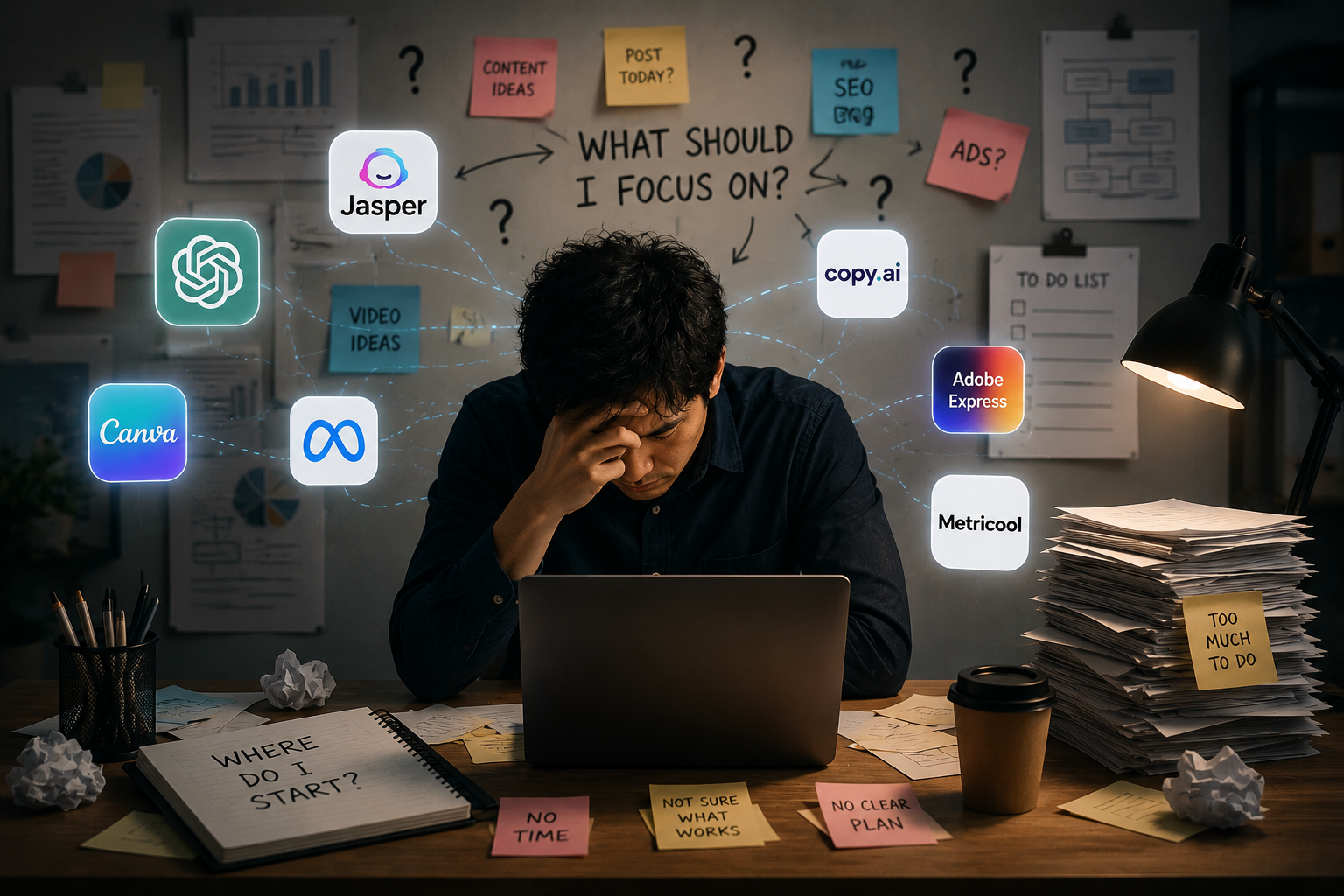
SMEs often collect tools but do not have a strategy that tells them what to focus on. Without direction, every platform and trend feels urgent, and marketing becomes reactive.
2. Inconsistent brand message creates content that doesn’t convert
If your value proposition and positioning are unclear, the content will feel scattered. You might post often, but people still do not understand what you do, who you serve, or why you are the right choice.
3. No content system (planning, approval, production, distribution)
AI can generate drafts, but SMEs often lack a workflow that turns drafts into published content consistently. Without a system, marketing becomes a cycle of starting and stopping.
4. Posting becomes reactive instead of strategic
Many businesses post when they feel pressured to “be active” rather than following a planned content approach tied to business goals and customer journeys.
5. Lack of performance review leads to repeated mistakes
Without proper review, SMEs repeat content formats that do not work and miss opportunities to double down on what actually drives enquiries and trust.
AI Era Marketing Reality: Strategy Matters More Than Content Volume
AI increases content supply, but it does not increase customer attention. Attention is still limited, and generic content blends in quickly because it is easy to produce.
Original content stands out. It reflects real experience, real thinking, and proof. Customers still buy based on trust, clarity, and credibility. Brands that win in 2026 are those that show up consistently with strong storytelling, evidence of results, and messaging that is easy to understand.
Tools can accelerate production, but strategy is what makes content meaningful and effective.
What to Look For in an Agency in 2026
1. Strategy-led approach, not just deliverables
Be cautious of agencies selling “X posts per week” as the strategy. A good agency starts with goals, audience, positioning, and a plan, then uses deliverables to execute that plan.
2. Ability to use AI properly without losing originality
A strong agency understands AI and uses it to speed up workflow, but ensures your content still sounds like your brand and stays original rather than templated.
3. Clear link between marketing activity and business outcomes
You should be able to see how content connects to outcomes like enquiries, leads, pipeline, and conversions, not just reach and likes.
4. Strong reporting and accountability
A good agency reports clearly and recommends what to do next. You should not feel like you are paying for activity without direction.
5. Capability across key touchpoints (social, video, SEO, website)
In 2026, growth usually needs multiple touchpoints. Agencies should understand how these channels support each other rather than treating them as separate jobs.
6. Consistent brand voice and creative direction across channels
If your content looks and sounds different across every channel, trust drops. The right agency protects your brand identity everywhere.
A Simple Framework: AI Only vs Hybrid vs Agency Led
| Option | Best for | Risk | Outcome |
| AI only | Solo founders, early stage | Inconsistency, generic output | Slow, unpredictable |
| Hybrid | SMEs with some internal support | Needs leadership | Steady improvement |
| Agency led | SMEs wanting growth and speed | Must choose right partner | Stronger momentum |
AI-only can work if you are early-stage and simply need to start publishing. Hybrid works well when you have internal ownership and want AI to speed up output. Agency-led makes sense when you need momentum, consistent execution, and expert direction without overloading your team.
How Neu Entity Helps Businesses Market Better in the AI Era
1. Brand clarity and messaging that guides every piece of content
We start by clarifying your positioning, audience, and messaging so every piece of content has a purpose and supports your business goals.
2. Content systems built for consistency, not random posting
We build content pillars, funnels, and publishing rhythms that your business can sustain, so marketing stays consistent even when you are busy.
3. Original content creation with a distinct voice and visuals
We help you create content that reflects your brand, your thinking, and your real proof, not generic posts that disappear in the feed.
4. Performance tracking and ongoing optimisation
We track what matters, review performance, and refine content and campaigns so your marketing improves month by month.
5. AI-assisted workflow with brand-led output
We use AI where it helps speed up execution, but the strategy, direction, and brand voice remain human-led and consistent.
Conclusion and CTA
AI is powerful, but marketing is more than generating content. It is positioning, consistency, proof, and accountability. Businesses still need agencies in the AI era when they want clarity, a system that works, and marketing that leads to real outcomes.
If you feel like you have tools but still cannot create consistently, or your content is active but not converting, it may be time to work with a partner who can bring structure and direction.
Talk to Neu Entity: https://neuentity.com/contact-us/
Let’s Talk!
If what you see here is relevant for you and can help you grow your business or organisation, we’d love to discuss further with you. Drop us a message or schedule an appointment with us.